
Freeport Council Advances East-West Bypass Study, Charts Financing for Bulldog Road Wastewater Plant
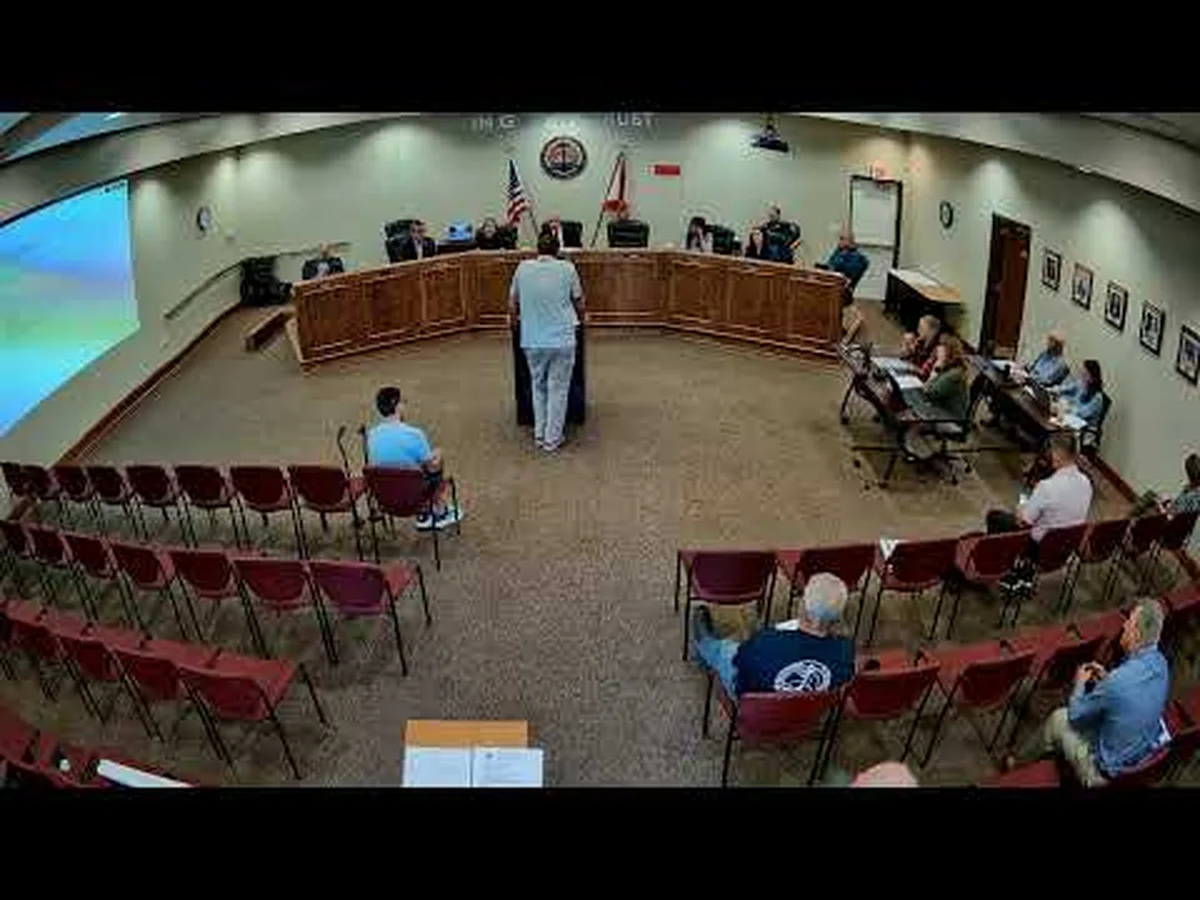
The Freeport City Council took two of the city’s largest infrastructure questions a step forward Tuesday morning, approving a planning study of six possible routes for an east-west bypass and giving its financial advisers the go-ahead to set up a line of credit that will keep the Bulldog Road wastewater treatment plant moving. The council also awarded $314,390 in long-delayed sewer repairs, welcomed back the annual Guns and Hoses charity softball tournament, and heard a sobering warning that the state’s four-laning of Highway 20 could eventually leave the city with a substantial utility-relocation bill.
The council convened at 9 a.m. Tuesday, October 13, in the chambers at City Hall for its first regular meeting since the recent storm, and Mayor Russ Barley opened with relief on everyone’s behalf. “Hope you made it out through the storm — wasn’t too bad for us,” he said, echoing the invocation that had given thanks for the city being watched over through the weather. With no public comment, the council approved a consent agenda covering the city’s bills, the minutes of its September 24 meeting, and the suspension of delinquent utility disconnections during November and December.
Before the staff reports, Barley presented the city’s employee honors: April Nickens was named Employee of the Month, and Bruce Simmons, the city’s finance director, was recognized as Supervisor of the Quarter — both, the mayor said, for their dedication, passion and hard work on behalf of Freeport’s residents.
City Manager Mark Martin then brought up the morning’s first action item: a scope of services with North Florida Professional Services to study an east-west bypass that would carry traffic from State Road 20 to the Business 331 corridor on the north side of town. An engineer with NFPS — the firm already designing improvements at the State Road 20, Business 331 and Madison Street intersection — told the council the study will evaluate six separate alignments that can be grouped into three north-south legs and two east-west legs, depending in part on the cooperation of the Air Force base. He described the work as “a planning level analysis” that will return with cost estimates covering environmental impacts, construction and right-of-way acquisition. The council approved the scope.
Engineering followed with a brief request to advertise for construction bids on the boardwalk and overlook at the Barrier Free Park — the final phase of that project. The council voted to put the work out to bid.
The longest discussion of the morning belonged to the Bulldog Road wastewater treatment plant. Martin said he placed the item on the agenda so that everyone involved could hear where the financing stands in the same room. “Bruce and I have brought this as close to getting done as we can get it,” he said — but what remains is a sequence of moving parts that depend on one another, which is why he wants the council kept in the loop as the pieces fall into place.
The plant’s design engineer reported that the construction documents will be ready to bid as early as November, though the state agency overseeing the financing has recommended that the city not advertise until after the first of the year, a move meant to compress the gap between the first and second rounds of funding. The city has been approved for $20 million through the State Revolving Fund — the first pot of money, which starts the project clock — but the size of the second allocation won’t be known until August, and the program wants every dollar of the project’s funding lined up before construction begins. A USDA loan being assembled by the city’s financial advisers is meant to complete the stack, and advisers told the council the second tranche could run as high as $30 million depending on how federal money trickles down to the state.
To bridge the gaps, PFM, the city’s financial advisory firm, recommended a revolving line of credit that would let the city pay its contractors while it waits on state reimbursements rather than exposing the general fund to a cash crunch. Under the plan, lending institutions would compete for the ability to lend the city up to $20 million at any one time, drawn only as needed — the way a homeowner taps a home equity line — with carrying costs in the low five percent range, the firm’s managing director said. Borrowing long-term at today’s interest rates is unattractive, he told the council, and “the more liquidity we can build into this plan without having to pay interest cost on borrowed money, the better.” The process takes about ten weeks from request for proposals to a recommendation, after which the council will be asked to approve a resolution placing the line of credit. The council voted to give the go-ahead.
The parks department returned with two community items. The council approved the Guns and Hoses softball tournament’s use of fields 4 and 5 at the Hammock Bay Sports Complex on November 21 for its annual charity tournament, which donates its proceeds to first-responder families battling illnesses, including cancer, and to other local causes. Parks staff also reminded residents of the city’s trunk-or-treat at the sports complex on Saturday, October 24, from 5 to 8 p.m., with free food and a bounce house.
Sewer Director Paul Johnson closed out the staff reports with the morning’s biggest spending items: three rehabilitation contracts, all with Martin Construction of DeFuniak Springs, the only vendor the department found able to take the work. The council approved $132,150 to rehabilitate the Lafayette lift station on Highway 20, $125,750 for the Lazy Days lift station, and $56,490 to line five manholes — $314,390 in all. Staff said the department had been trying to get the jobs done for more than a year.
The approvals came with some bookkeeping. A council member noticed the packet carried a higher figure for the Lafayette station than the number staff quoted, and Johnson explained that after the original estimate came in, he went back to the contractor and worked out the pieces his own crews could handle — the bypass pumping and monitoring — bringing the price down. A similar discrepancy surfaced on the Lazy Days station, where staff initially quoted $137,250 before a council member pointed to the packet’s $125,750 estimate; after confirming that figure already accounted for the sewer department covering the bypass work, the lower number prevailed. “I’m glad you can get these projects done and we’ve been waiting a year,” one council member said, adding thanks that the department finally found somebody to do the work.
The storm that had just passed drew praise as the formal agenda wound down. One council member thanked the water and sewer crews — singling out operator Larry, who “stayed up continuously watching our well monitoring” through the storm — noting that Freeport came through with no boil-water notices and no water main breaks while other communities lost service. Parks crews were already clearing the city’s fields, and details of a countywide storm-debris pickup, with separate crews working limbs and other debris continuously until the cleanup is finished, were being posted to the city’s Facebook page.
The meeting’s final briefing came during public comment, when a consulting engineer who has worked with the city — speaking at Martin’s request — laid out where the Florida Department of Transportation’s long-planned four-laning of Highway 20 through town actually stands. The news was mixed. DOT has funded 100 percent of the construction design, and its designers have completed 60 percent plans. But right-of-way acquisition and construction are not in the department’s five-year work program at all — and the right-of-way, the engineer noted, will cost more than the road itself. At a meeting with DOT officials two or three weeks ago about the Jackson intersection, he said, the state’s people suggested it could be as long as ten years before the right-of-way is even purchased, unless “a pile of money falls from the sky.”
The engineer warned that the details will cost Freeport long before any asphalt arrives. The 60 percent plans show utilities conflicting with the roadway in many places, and the new Lafayette Creek bridge would run close to three times the length of the existing span, complicating access to the city’s lift station there. DOT’s position — already put in writing — is that it buys right-of-way only for its own improvements, not for the city’s water and sewer lines, leaving Freeport a substantial relocation expense the city has not yet been able to estimate. His advice was to fight for utility corridors in the design now, because the same work will be “way more expensive” a decade from now. Asked whether the utilities can be moved at all, he was blunt: “If you have enough money, anything’s possible.”
The update surprised at least one council member, who had assumed the project was shelved. “I’m shocked. I thought it was shelved for a while,” the member said. “I’m super happy to hear that at least they’re starting something.” Martin said the briefing was deliberate: too often, he said, councils don’t hear about such projects “till somebody walks up there and says, ‘20 million or whatever million’” — and big numbers are coming the city’s way. With no further public comment, the meeting adjourned. The council’s next regular meeting is scheduled for 6:30 p.m. on Thursday, October 22, at City Hall.
Originally reported by the City of Freeport. Meeting video: City of Freeport via YouTube. Image: City of Freeport via YouTube.
