
Walton County Public Safety Leaders Warn Amendment 3 Threatens Emergency Funding
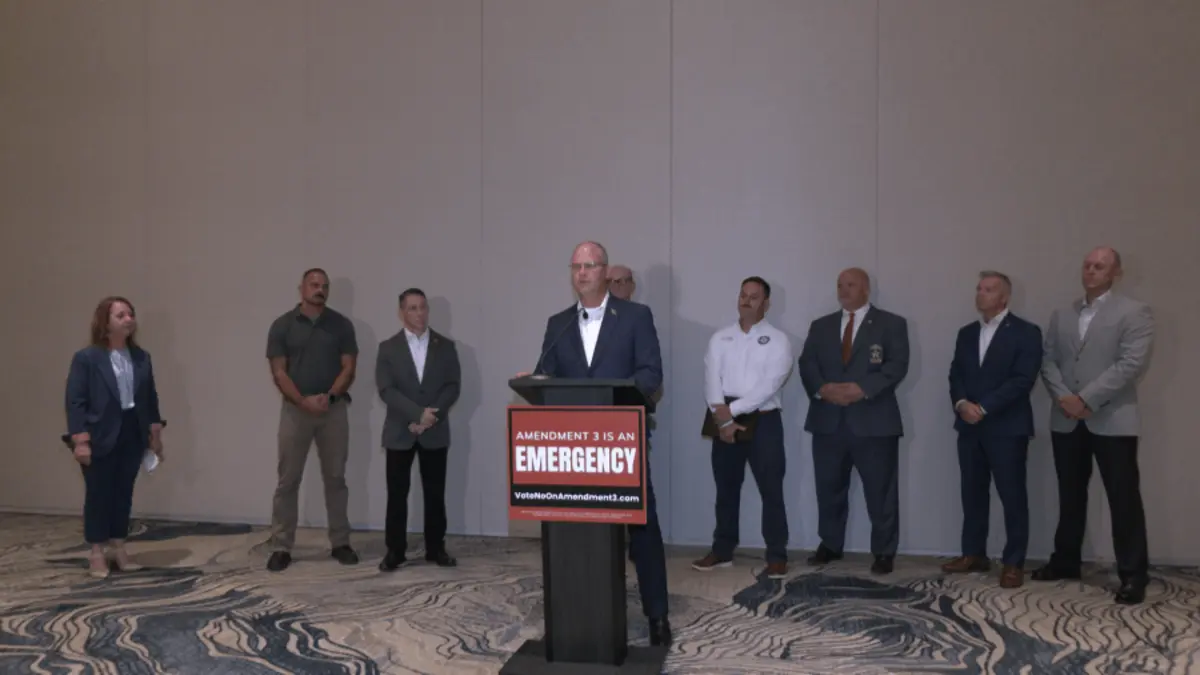
Fire chiefs, sheriffs and emergency services leaders across Walton County are urging caution on Amendment 3, the property tax overhaul Florida voters will decide in November, warning that the revenue that keeps firefighters, paramedics and deputies ready to respond in Freeport could be on the line.
The warning was sounded this week by Walton County’s own public safety leadership, including South Walton Fire District Fire Chief Ryan Crawford, who serves as president of the Florida Fire Chiefs’ Association, and Walton County Sheriff Michael Adkinson, whose office patrols and answers calls across the Freeport area every day.
Amendment 3 would raise Florida’s homestead exemption for non-school property taxes from the current $50,000 to $150,000 in 2027 and $250,000 beginning in 2028, and would lower the annual assessment cap on non-homestead property from 10 percent to 5 percent. The same measure was approved by the Legislature in June for placement on the Nov. 3 General Election ballot, where it will need 60 percent voter approval to pass and take effect Jan. 1, 2027. The full text of the amendment is published by the Florida Senate.
“Just sustainable funding for public safety, right? Like, how are we going to sustain the core services that citizens depend on day in and day out when you have this diminishing revenue source?” Crawford said.
The concern is not hypothetical for Freeport residents. Walton County government and the countywide emergency services it helps fund, including the Walton County Sheriff’s Office, stand to lose recurring revenue that pays for staffing, equipment and response readiness in communities north of the Choctawhatchee Bay, including Freeport. Crawford noted the hit will not land evenly: tourist-heavy areas with a small share of homestead properties will feel it differently than rural counties.
“What impacts a sheriff in South Walton from the tax reform standpoint, will be very differently affected in communities like Bonifay or the Panama City Beaches, because they have a much higher percentage of homestead properties,” Crawford said.
Adkinson, whose agency provides law enforcement coverage for Freeport, said leaders need to understand the financial consequences before the state rewrites its tax structure. “You have to, the potential impact across the state is really significant. More so particularly on cities,” Adkinson said. He told WJHG the measure risks becoming “a bait and switch” for voters expecting simple tax relief: “What I don’t want is for this to become the fee state, so that when we cannot sustain acceptable levels of public safety service that everything becomes a fee, or we add new taxes to do that.”
Fire officials add that Amendment 3 does list public safety among the permitted uses of whatever property tax revenue remains, but it does not establish a minimum funding level or replace any revenue local governments lose. Unlike counties and cities, independent fire districts have few ways to backfill a shortfall without returning to voters for approval.
Crawford said many Floridians will mark their ballots without fully understanding what is at stake. “The legislature has put this on the ballot for voters to decide on. And I think a lot of people are making a decision that may not understand all the consequences of that decision,” Crawford said. “When someone calls 911, they’re not thinking about homestead exemptions, taxable value, or millage rates; they simply expect someone to answer, and somebody to come.”
Not everyone shares the alarm. Florida Realtors, the state’s largest trade association, has endorsed Amendment 3, as has the Republican Party of Florida. Supporters point to the savings it would deliver to homesteaded homeowners, including the many Freeport families whose primary homes make up the bulk of the local tax base.
The decision now rests with voters, who will find Amendment 3 on the Nov. 3 General Election ballot.
Originally reported by MyPanhandle and WJHG. Image: MyPanhandle.
